
Facilitators Team





Workshop Scope
This workshop introduces TinyML as the ultimate destination of efficient machine learning, covering efficiency in parameters, data, computation, and energy. It begins with an introduction to TinyML and its differences from Edge AI and Cloud AI. The scope is divided into four areas:
- Compression methods – pruning, quantization, and distillation to make large models tiny.
- Parameter-efficient architectures – approaches for building efficient models.
- General resource efficiency – data, energy, and connectivity (sparsity) considerations.
- Deployment of TinyML – on devices like Arduino, STM32, Raspberry Pi, and mobile using TensorFlow Lite.
Hands-on sessions in all areas will help participants balance accuracy, latency, and memory for real-world deployment in constrained environments.
Timeliness of the Workshop
1. Lack of TinyML related publications in local conferences
Methodology
To validate this observation, we analyzed the metadata (keywords, abstracts, titles, etc.) of proceedings from five major local conferences published in IEEE Xplore. We focused on papers published after 2020, with the exception of ICIIS, for which 2019 was also included. The conferences analyzed were:
- International Conference on Advancements in Computing (ICAC)
- International Conference on Advanced Research in Computing (ICARC)
- International Conference on Industrial and Information Systems (ICIIS)
- Moratuwa Engineering Research Conference (MERCon)
- International Research Conference on Smart Computing and Systems Engineering (SCSE)
Findings
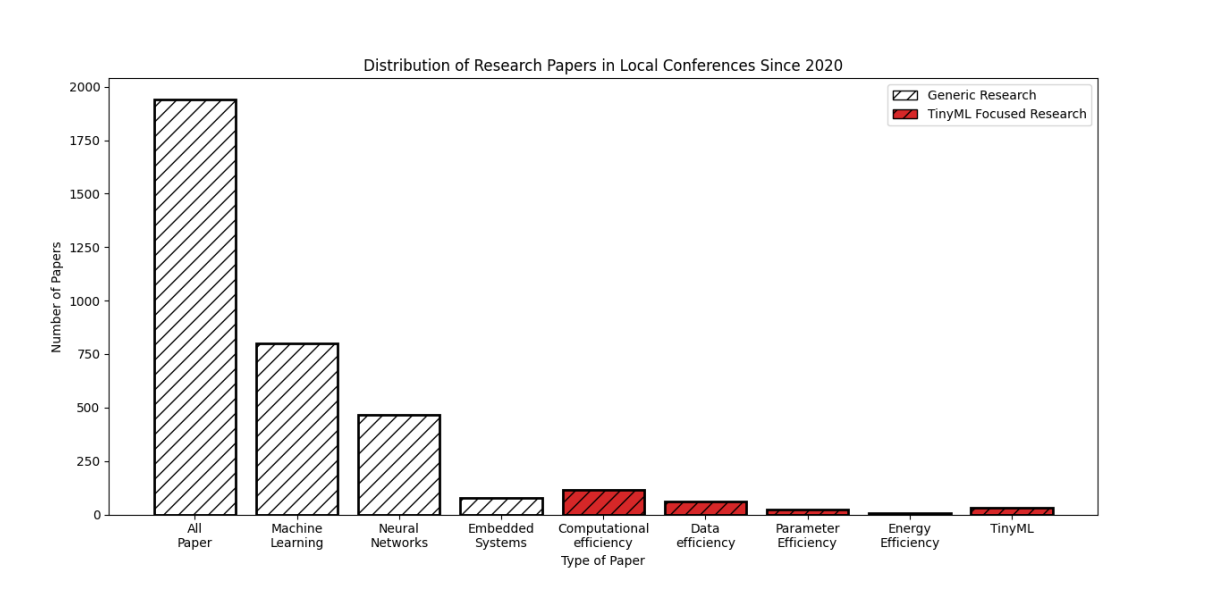
Given that most papers published at local conferences are from undergraduate students, this shows a lack of exposure to TinyML and related research domains. Given that capstone projects (final year research) generally reside in application domains, TinyML can add novelty potentially making them experimental research work. Thus TinyML is an ideal research direction for undergraduate students and we hope to give the necessary exposure to them through this workshop so that they can do research work in this domain.
The codes are openly available on GitHub
2. Large size of Foundational Models
Second, the global AI landscape is shifting with the rise of large foundational models (ex: LLM, LLVM etc.) at fast pace. Resultant models are large in size and the required data (Kaplan et al., 2020) and it seems this is not going to change in the near future. Thus, there is a requirement to make these models smaller and efficient. TinyML and the related techniques in these research areas can help achieve this.
3. Sensor data analysis in engineering domains
The explosion of sensor-rich environments and IoT systems presents a growing demand for AI solutions that are private, responsive, and energy-efficient—capabilities that TinyML directly supports. This is specially needed for Industry 4.0, 5G and beyond where massive machine type communication (mMTC) is an important pillar. Engineering domains can all take advantage from TinyML and related work to improve their fields
4. Brain-Inspired Architectures
While all previous rationales are application focused, there is also a scientific rationale for TinyML which is that all these road (i.e., different efficiencies such as data-efficiency) while they lead to TinyML they also lead to brain-like architectures (Somathilaka et al., 2024) since all those efficiencies have similarity to brain functionalities.
5. Democratization of AI
AI technologies such as DeepMind’s AlphaFold, Tesla’s end-to-end autonomous driving stack, and OpenAI’s GPT models have shown how machine learning can revolutionize scientific and engineering processes. However, these breakthroughs are often locked behind massive computational infrastructures accessible only to large corporations. TinyML, with its focus on computation, parameter, and energy efficiency, presents a unique opportunity to democratize AI. By dramatically reducing the cost and hardware requirements for inference, TinyML allows researchers, students, and engineers especially in the global south to integrate AI into real-world engineering workflows. The efficiency paradigm championed by TinyML shifts the focus from centralized, high-cost models to decentralized, low-power systems that enable AI at the edge.
Workshop Agenda
| Start Time | End Time | Duration | Topic | Presenter |
|---|---|---|---|---|
| 9:00 AM | 9:05 AM | 5 mins | Introduce the speakers | Dr Mahima |
| 9:05 AM | 9:20 AM | 15 mins | Introduction to the workshop | Mr Sanka |
| 9:20 AM | 10:20 AM | 60 mins | Introduction to ML/AI and TinyML | Dr Nushara |
| 10:20 AM | 11:35 AM | 75 mins | Model compression techniques: Part 1 | Dr Dinuka |
| 11:35 AM | 11:45 AM | 10 mins | Break | - |
| 11:45 AM | 1:30 PM | 105 mins | Model compression techniques: Part 2 | Dr Dinuka |
| 1:30 PM | 2:00 PM | 30 mins | Break | - |
| 2:00 PM | 3:00 PM | 60 mins | Bio-inspired efficient architectures | Ms Madusha |
| 3:00 PM | 4:00 PM | 60 mins | Compression techniques - Hands-on session | Mr Asiri |
| 4:00 PM | 4:05 PM | 5 mins | Break | - |
| 4:05 PM | 4:55 PM | 50 mins | Efficient architectures and other efficiencies in ML | Mr Sanka |
| 4:55 PM | 5:00 PM | 5 mins | Concluding the session | Mr Sanka |
Join the Workshop
Scan the QR codes below to register or join the workshop directly via Zoom.

Register for the Workshop

Join via Zoom
Organizers

Dr. Dharshana Kasturirathna
Sri Lanka Institute of Information Technology (SLIIT)



.png)

.png)


Organized by BrAINLabs Research Group and Faculty of Engineering, SLIIT
Funded by SLIIT Research & International (Grant No. PVC(R&I)RG/2025/12)
This site is created by
Savini Kommalage
and currently maintained by
BrAINLabs Research Group.
Original website can be accessed via
this link.
This page was generated by
GitHub Pages.